

[LMD communicates] Disappearance of Hector Teitelbaum
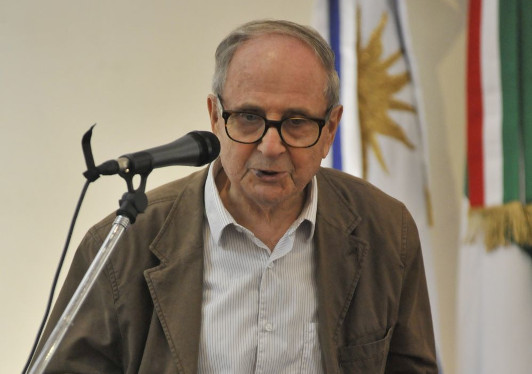
Born in Argentina in 1925, Hector Teitelbaum trained as a dentist. Following the military coup of 1962 and a spell in prison for political activism, he left Argentina and moved to France. The physics studies he had pursued in parallel enabled him to be accepted as a doctoral student at the Service d’Aéronomie. He defended his doctoral thesis in 1965, on the “Measurement of the internal scale of atmospheric turbulence between 80 and 100 km.” Hector worked on these topics with Claude Sidi, then with Jacques Blamont on the characterization of atmospheric tides. He also contributed, as an extension of the work of Holton and Lindzen, to explaining the forcing of different wave modes on the general circulation of the middle atmosphere.
He left the Aeronomy Service in the early 1980s and joined François Vial, then his doctoral student, at the LMD at the École Polytechnique. Hector and François continued their work on atmospheric tides and their interactions with planetary waves. In particular, they highlighted a signature of the quasi-biennial oscillation in the semi-diurnal pressure tide signal, observed on the ground for over a century in meteorological archives.
Following the discovery of the hole in the ozone layer in 1985, Hector and Robert Sadourny proposed to CNES that they reproduce the Éole experiment in order to study the dispersion, at mid–latitudes, of ozone–depleted air masses from the polar stratospheric vortex. This marked the beginning of the Stratéole project.
Hector then continued his research at the ENS. His insatiable curiosity led him to tackle a wide range of subjects, all related to atmospheric dynamics: the generation and propagation of gravity waves, water vapor transport, and mini ozone holes. He also contributed to studies in mountain meteorology by combining theoretical work with François Lott, state-of-the-art satellite observations (AIRS) with Joan Alexander of the NWRA, and the use of in situ data and reanalyses of convection around the Andes with Hervé Le Treut and Fabio D’Andrea. As he liked to point out, he had never been more productive than in the 2000s, when he was over 70 years old. Argentina finally awarded him the RAICES prize in 2012, which recognizes Argentine expatriates who have distinguished themselves in the fields of science and technology.
Hector Teitelbaum was a leading specialist in the dynamics of the middle atmosphere. He contributed to the training of many researchers working at the LMD or in other laboratories around the world. He was also a man of great culture, mischievous, lively, humanistic — with a touch of misanthropy at times — with whom it was a pleasure to talk in his office, which he occupied daily until the early 2020s.
The LMD will remember Hector Teitelbaum fondly and gratefully for his many contributions over nearly forty years.