

[LMD communicates] Enora Moisan’s PhD defense
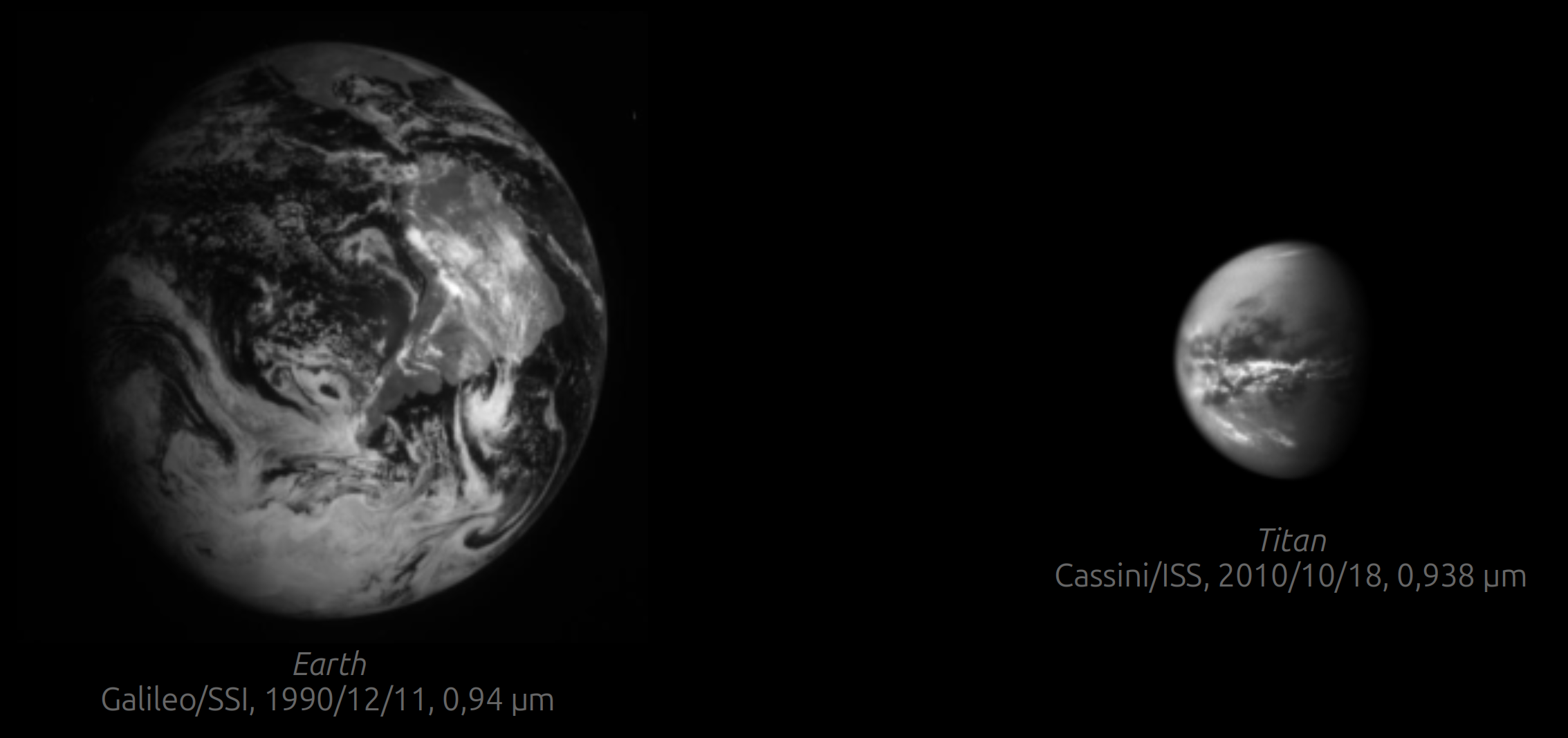
Title: Numerical simulations of convective clouds on Titan, links to the methane cycle, and comparison to Cassini/ISS observations
Date: 2026/09/17, 2pm
Abstract:
The aim of this thesis is to better assess the effect of methane lakes and methane clouds on the methanologic cycle of Titan, the largest moon of Saturn.
With this in mind, we perform simulations with a regional model called mtWRF, based on the WRF model (standing for Weather, Research and Forecasting model), adapted to Titan. WRF is used in many research studies, and routinely for weather forecast on Earth. We use mtWRF in 2D, focusing on the atmosphere around a small methane lake. The aim is to evaluate the effect of adding a surrounding topography, changing the surface properties of the lake shore, and varying the season. We find that topography, season and the surface roughness of the shore have an impact on the amount of methane evaporated from the lake and on the mixing of this methane in the planetary boundary layer. As a result, it influences the amount of methane available for a potential cloud to form close to the lake.
We then propose a reanalysis of cloud images from the Imaging Science Subsystem (ISS), a set of two cameras that was onboard the Cassini-Huygens mission, a spacecraft that explored the Saturnian system from 2004 to 2017. We focus on determining the cloud area and the cloud shape, two elements that were not available in previous extensive cloud databases. Clouds are classified in four cloud types: isolated small clouds, cloud clusters, streak clouds and global storms. These cloud types are found to form at preferential seasons and locations on the surface of Titan. An attempt is made at quantifying the aggregation of clouds by applying the Iorg organization index to some images.
To evidence the mechanisms behind the formation and evolution of the observed clouds, we develop a new cloud resolving model adapted to Titan. To do this, we couple two models: the physics of the Titan PCM, and the dynamics of the WRF model. Titan PCM is a well-known model describing the physical phenomena of Titan’s atmosphere. With this new coupled model, single convective cloud cells are simulated. The modeled clouds reach the tropopause in some configurations. We obtain strong surface winds, reaching more than 20 m/s, and updrafts as high as 50 m/s during the development phase of the cloud. By varying the inputs and the radiative transfer to match the conditions at specific seasons and latitudes, we find that clouds form preferentially at some locations and at certain times of the year, in accordance with observations. An experiment with a high model top generates a localized stratospheric enhancement of methane. This is a first step in reproducing the observed variations of methane abundance in the stratosphere of Titan.
Supplementary Information:
The defense will be held in English.
Location: Salle de l’UFR, 46-56 N2
Visio:
https://zoom.us/j/99938290468
ID: 99938290468, pass: 529699
Composition of the jury:
Solène TURQUETY — Présidente
Erika BARTH — Rapportrice
Sébastien RODRIGUEZ — Rapporteur
Nicolas ROCHETIN — Examinateur
Elizabeth TURTLE — Examinatrice
Manuel LÓPEZ-PUERTAS — Examinateur
Ricardo HUESO — Invité
Aymeric SPIGA — Directeur de thèse
Audrey CHATAIN — Co-encadrante de thèse