

[LMD publishes] Mars CO₂ atmospheric chemistry: solving the CO deficit reveals a new H₂ surplus
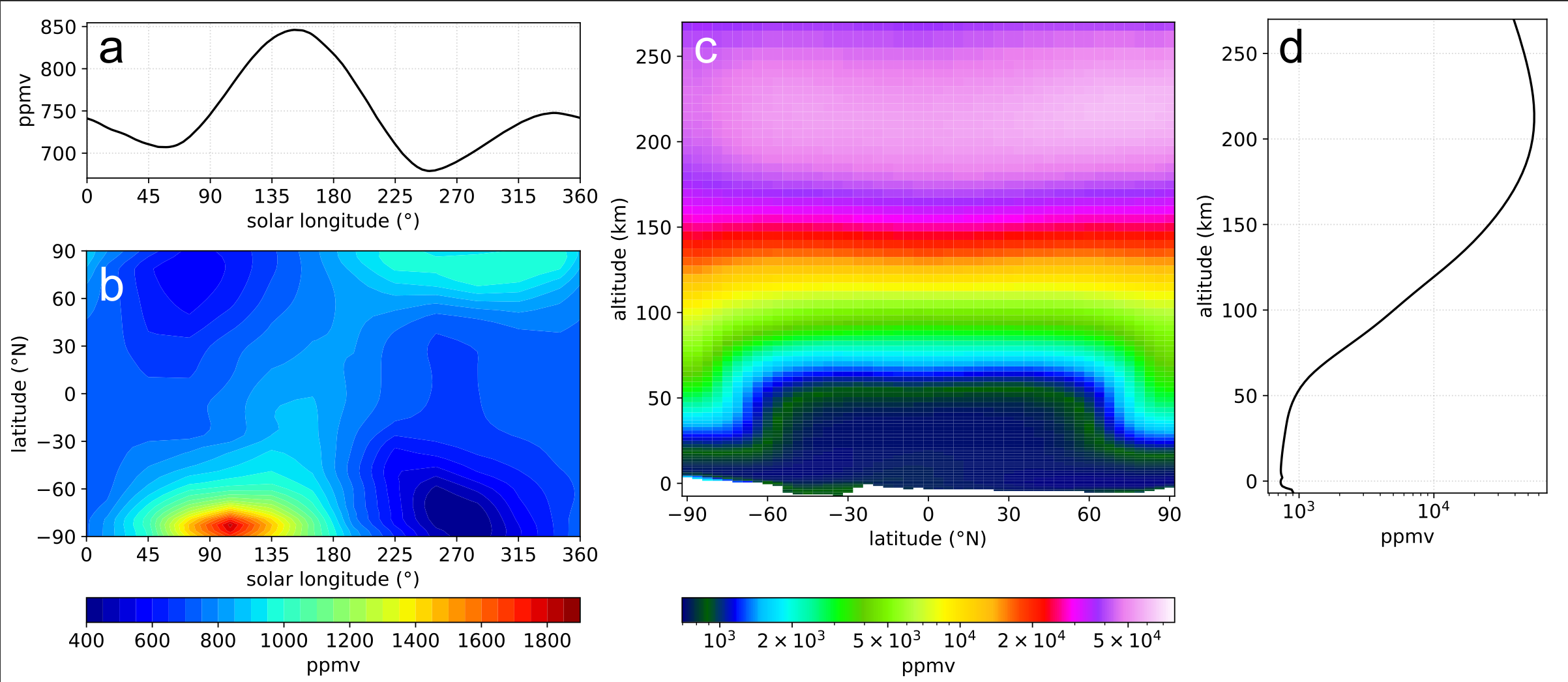
Yangcheng Luo and his collaborators published an article (link below) explaining the observed abundance of carbon monoxide (CO) in Mars’s atmosphere. This has long posed a challenge for atmospheric models. Traditional one-dimensional photochemical models underestimate the abundance of CO by up to a factor of seven compared with observations. In our new study, we performed the first long-term three-dimensional simulations of long-lived chemical species in the Martian atmosphere using the Mars Planetary Climate Model coupled with photochemistry. With a more realistic distribution of atmospheric water vapor, the model predicts a globally averaged CO mixing ratio of about 700 ppmv, much closer to the 800–960 ppmv retrieved from observations than previous one-dimensional results. Sensitivity experiments show that uncertainties in chemical reaction rates could potentially explain the remaining gap between the modeled and observed CO abundances. However, solving the CO deficit reveals a new puzzle: these simulations predict substantially more molecular hydrogen (H₂) than observed. The long-standing “CO-deficit problem” may therefore be giving way to a new “H₂-surplus problem.”
Figure: Spatiotemporal distribution of CO modeled by the Mars Planetary Climate Model. (a) Seasonal variation of CO mixing ratio. (b) Seasonal and meridional distribution of column-averaged CO mixing ratio. (c) Vertical and meridional distribution of CO mixing ratio. (d) Vertical distribution of CO mixing ratio.
https://doi.org/10.1016/j.icarus.2026.117170