

[LMD publishes] Modeling the coupled and decoupled states of polar boundary-layer mixed-phase clouds
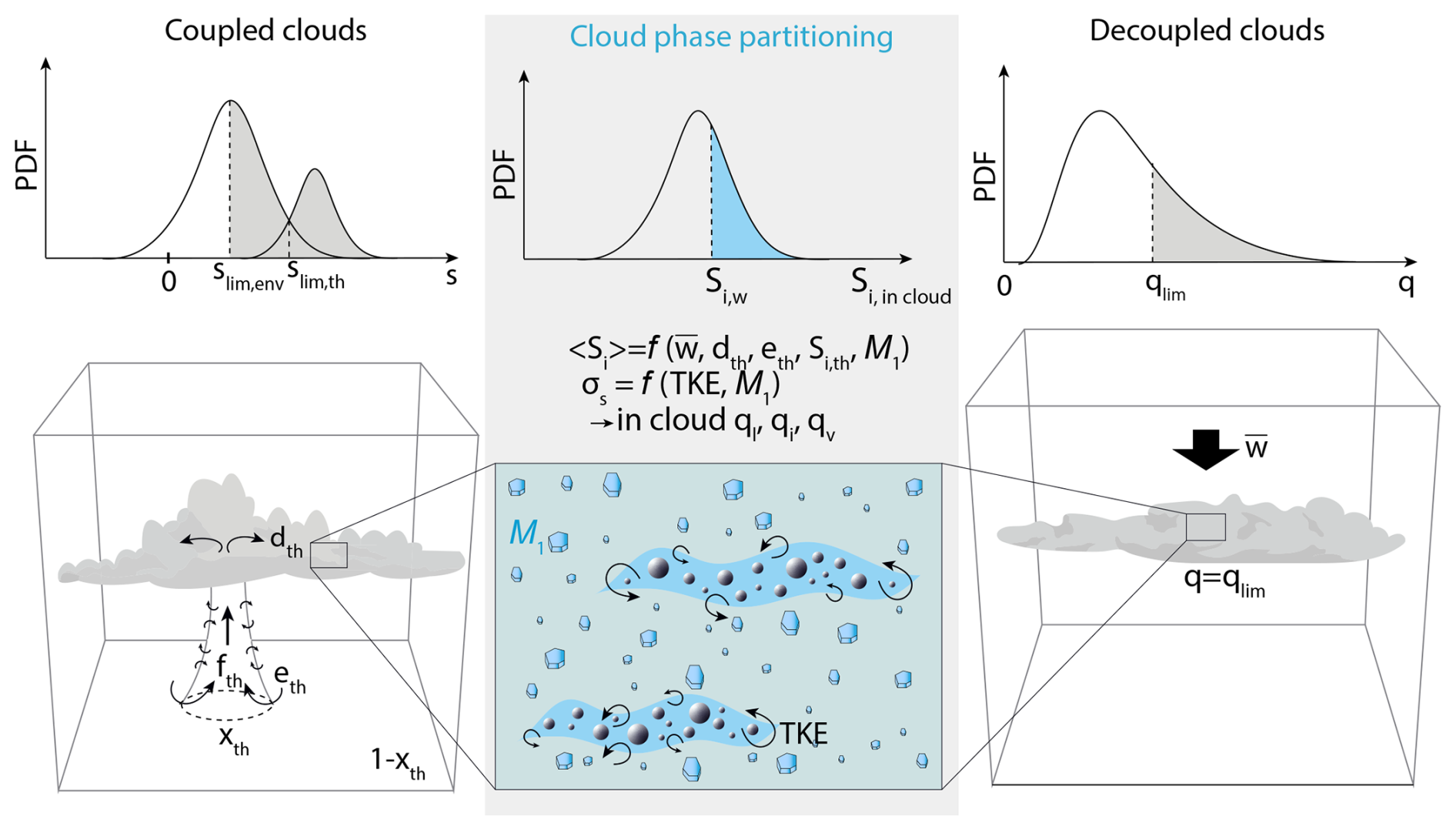
Low-level clouds in polar regions are very often mixed-phase clouds, composed of both liquid water droplets and ice crystals. Their accurate representation in climate models remains a major challenge, due to the complex interactions between microphysics, turbulence and radiation, and their strong sensitivity to subgrid-scale parameterisations.
This study introduces an important advance in the modelling of these clouds by developing a novel subgrid parameterisation that better represents the interactions between turbulent structures and clouds within a climate model. The approach explicitly distinguishes between coupled states (when the cloud layer is connected to the surface through turbulent mixing) and decoupled states (when this connection is lost), two regimes that frequently occur in polar environments.
The results show that this new representation significantly improves the simulation of the vertical structure and microphysical properties of polar mixed-phase boundary-layer clouds. In particular, it better captures the observed variability of polar stratocumulus clouds, as well as their transitions between coupled and decoupled states, which strongly influence their evolution and radiative properties.
This work highlights the crucial importance of explicitly representing turbulence–cloud interactions in climate models, in order to reduce biases in the simulation of polar clouds and improve climate projections in high-latitude regions.
- Contact : Étienne Vignon (etienne.vignon@lmd.ipsl.fr)
- Link : Vignon, É., Raillard, L., Borella, A., Rivière, G., and Madeleine, J.-B.: Modeling the coupled and decoupled states of polar boundary-layer mixed-phase clouds, Atmos. Chem. Phys., 26, 1847–1865, https://doi.org/10.5194/acp-26-1847-2026, 2026.