[Le LMD en campagne] Start of the WHIRLS campaign
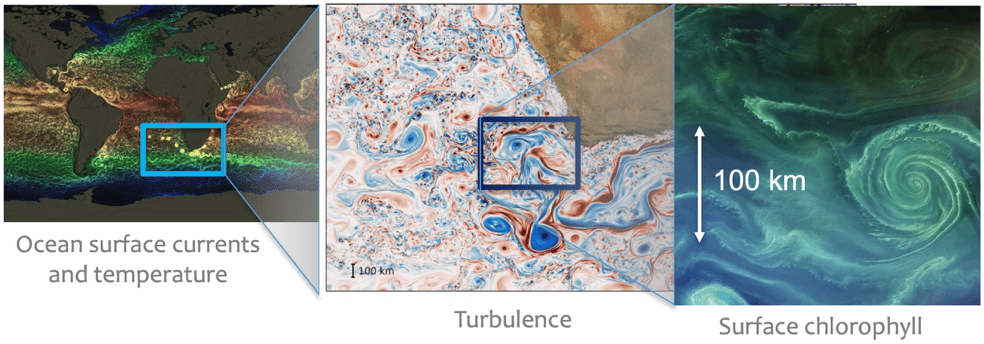
The international campaign WHIRLS observes for the first time the ocean, the atmosphere and life together.
From 20 June to 29 July 2026, two research vessels and a large fleet of autonomous platforms will deploy off the coast of South Africa, in the Agulhas Current region, one of the most energetic in the world ocean. Their ambition is unprecedented: to observe simultaneously and at very high resolution both the ocean and the atmosphere, covering in a single sweep their physics, their chemistry and the entirety of life, from viruses and bacteria to seabirds and marine mammals. The campaign forms the heart of the European ERC Synergy project WHIRLS.
The aim is to better understand small-scale ocean structures — eddies, fronts and filaments — which extend over only a few kilometres and evolve over just a few days, yet play a disproportionate role: they control the exchange of heat and carbon with the atmosphere, bring nutrients up to the surface and organise marine life. Difficult to observe, they remain one of the main sources of uncertainty in climate models.
To achieve this, the Marion Dufresne (France) and the SA Agulhas II (South Africa) will operate in concert as mobile observatories, supported by gliders, autonomous surface vehicles, around 200 drifters, profiling floats and some 300 atmospheric soundings. The campaign will also deploy a complete biogeochemical and biological programme, from the genetic analysis of plankton to the observation of fish, seabirds and marine mammals, and will provide a benchmark dataset for CNES’s SWOT satellite mission.
“For the first time, we are going to observe together, in the same place and at the same moment, the ocean, the atmosphere and all the life they harbour, from viruses to marine mammals. It is by bringing together these compartments, usually studied separately, that we will be able to understand how the ocean’s smallest structures act on climate and biodiversity.” explains @Sabrina Speich, PI of the ERC Synergy WHIRLS project and chief scientist of the research vessel Marion Dufresne
Many thanks to the project’s leaders and contributors:
GEOMAR, ENS-PSL, the University of Gothenburg and the University of Cape Town; French support: French Oceanographic Fleet (IR*), CNRS-INSU, CNES, IPSL, Data Terra, ENS-PSL and LMD.
More information:
Website: https://www.whirls.eu
Linkedin: https://www.linkedin.com/company/whirls/posts/?feedView=all
Instagram: https://www.instagram.com/whirls_eu/?utm_source=ig_web_button_share_sheet