Nous utilisons des cookies sur notre site Web pour vous offrir l'expérience la plus pertinente en mémorisant vos préférences et vos visites répétées. En cliquant sur "Accepter tout", vous consentez à l'utilisation de TOUS les cookies. Toutefois, vous pouvez visiter "Cookie Réglages" pour fournir un consentement contrôlé.
We use cookies on our website to give you the most relevant experience by remembering your preferences and repeat visits. By clicking “Accept All”, you consent to the use of ALL the cookies. However, you may visit "Cookie Settings" to provide a controlled consent.


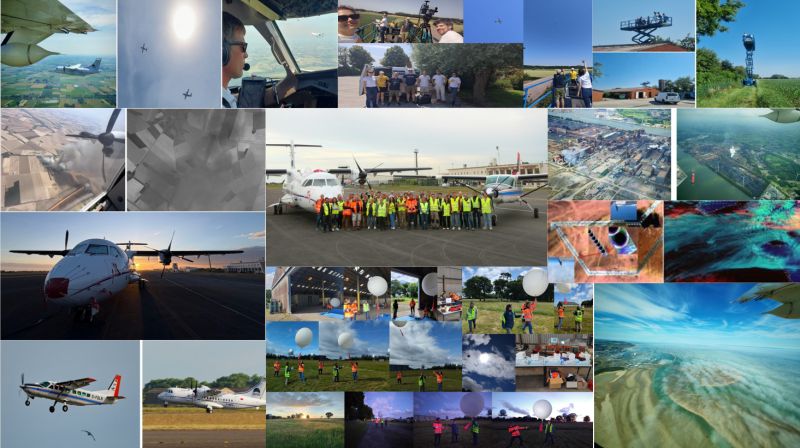
This campaign took place only a few months after the launch of three major European satellites dedicated to atmospheric observations: MTG-S, MicroCarb and Metop-SG-A1. Its main objective was to assess the capability of these new satellite missions to measure anthropogenic greenhouse gases, while preparing the next generation of European Earth observation satellites.
More specifically:
1) validate the measurements performed by the recently launched satellites (IASI-NG, 3MI, IRS, S4/5)
2) acquire new observations of greenhouse gases and atmospheric pollutants related to human activities (CO₂, CH₄, N₂O, CO, NH₃, etc.)
3) prepare future European space missions (SCALE, ECO, NitroSat, GHG space missions).
Two regions with particularly high emissions of methane, ammonia and carbon dioxide received enhanced monitoring: Brittany and Belgian Flanders. These regions provide ideal natural laboratories for testing the capability of current and future satellites to detect and quantify emissions related to human activities, particularly those from agriculture.
Fundings and participants:
CNRS
CNES
European Space Agency – ESA
EUMETSAT
BELSPO – Belgian Science Policy Office
AERIS DATA
Aerolab
Institut royal d’Aéronomie Spatiale de Belgique
Météo-France (CMS, CNRM)
CNES
German Aerospace Center (DLR)
Freie Universität Berlin
GFZ Helmholtz-Zentrum für Geoforschung
Imperial College London
Laboratoire d’Aérologie (LAERO)
LATMOS Laboratoire Atmosphères, Observations Spatiales
IPSL-Institut Pierre-Simon Laplace
Laboratoire de Météorologie Dynamique – IPSL
SIRTA
Laboratoire d’Optique Appliquée (LOA)
Lpc2e
Laboratoire des Sciences du Climat et de l’Environnement
SAFIRE
Université libre de Bruxelles
Swiss Flight Services SA
Logbook : https://lnkd.in/e2RShfNe
News IPSL : https://lnkd.in/enMgidWu
News INSU: https://lnkd.in/eUZ4sKtz
New ICI : https://lnkd.in/e2tZaqRf